

Introduction
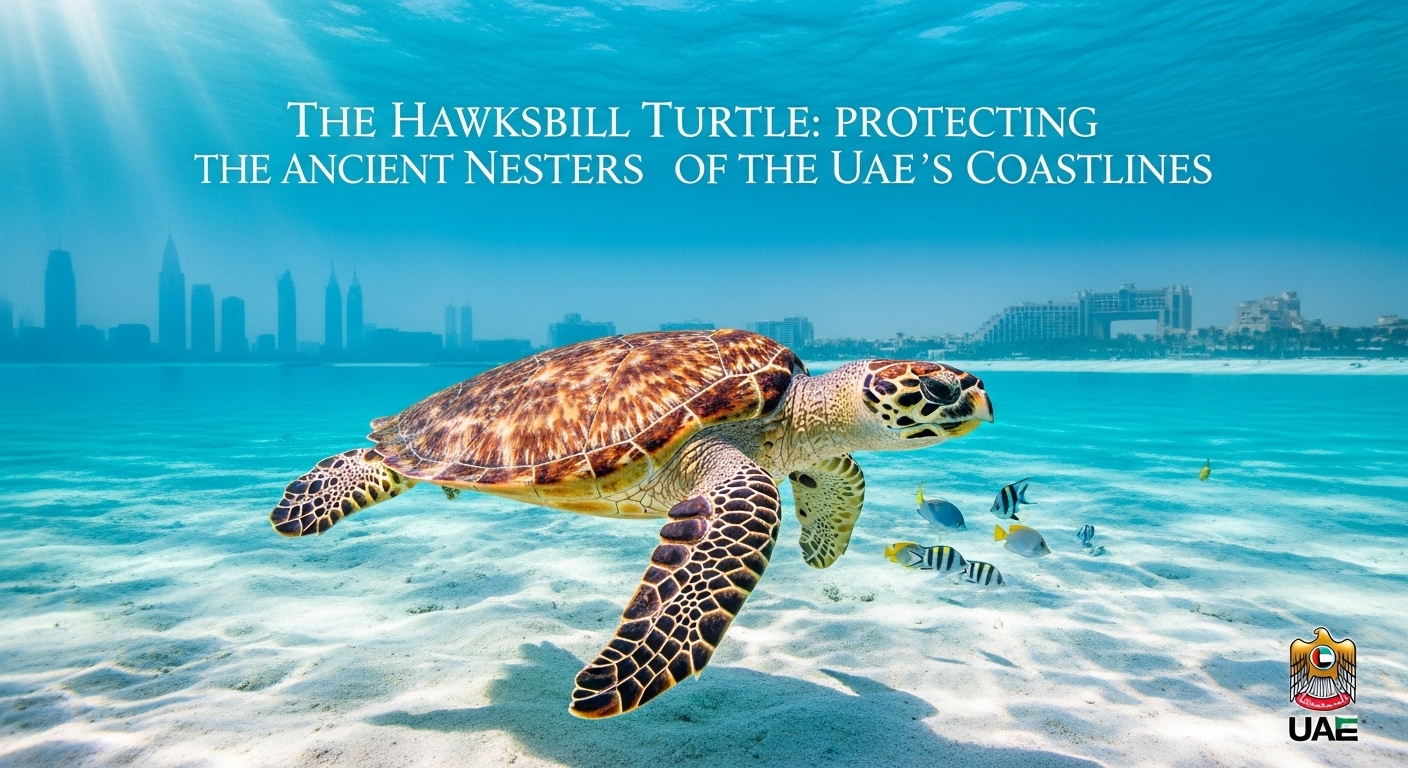
For millions of years, under the cover of darkness, the Hawksbill sea turtle has undertaken a timeless ritual on the beaches of the Arabian Gulf. These ancient mariners, with their beautifully patterned shells and sharply pointed beaks, emerge from the waves to lay their eggs in the warm sands of the UAE’s coastline. As a critically endangered species, the survival of the Hawksbill turtle is a global conservation priority. In the UAE, their nesting grounds have become focal points for intense protection and research, symbolizing the nation’s commitment to safeguarding its marine heritage and the fragile balance of its coastal ecosystems.
History
The relationship between humans and Hawksbill turtles in the Gulf region has been complex. Historically, they were hunted for their stunning “tortoiseshell,” which was used for ornaments and jewelry, and their eggs were collected for food. This, combined with habitat loss and accidental capture in fishing gear, led to a dramatic global decline. In the UAE, the rapid coastal development of the late 20th century posed a new threat, as nesting beaches were transformed into resorts and ports. However, since the 1990s, a concerted conservation effort has emerged. The late Sheikh Zayed bin Sultan Al Nahyan was a key proponent of their protection, and today, organizations like the Environment Agency – Abu Dhabi (EAD) run extensive monitoring and conservation programs.
Key Features
The life cycle of the Hawksbill turtle (Eretmochelys imbricata) is a story of epic journeys and survival against the odds:
- Specialized Diet: Their narrow, pointed beak is perfectly adapted for reaching into crevices in coral reefs to feed on their primary prey: sponges. This diet is crucial for the health of the reefs, as it prevents fast-growing sponges from outcompeting corals.
- Natal Homing: Female Hawksbills exhibit a remarkable behavior known as natal homing, returning to the very same beach where they hatched to lay their own eggs, sometimes traveling thousands of kilometers.
- The Nesting Process: Under the cover of night, the female laboriously hauls herself up the beach, digs a deep chamber with her flippers, and deposits around 100-150 eggs before covering the nest and returning to the sea. The entire process can take several hours.
- Precarious Hatchlings: After an incubation of about two months, the hatchlings emerge and make a perilous dash for the sea, guided by the reflection of the moon and stars on the water. Only an estimated 1 in 1,000 will survive to adulthood.
Cultural Significance
While not a central figure in Emirati folklore like the camel or the falcon, the Hawksbill turtle is part of the natural history of the coastal communities. Its presence signifies a healthy marine environment. Today, it has become an ambassador for marine conservation. The sight of a turtle nesting or hatchlings scrambling to the sea is a powerful, emotional experience that fosters a deep connection to nature and a sense of responsibility for its protection among both citizens and residents. It represents the fragile, ancient life that persists alongside modern development.
Modern Relevance
The protection of Hawksbill turtles is a major environmental priority for the UAE. Key nesting islands, such as Bu Tinah, Jarnain, and others, are now strictly protected marine sanctuaries where access is prohibited during nesting season. Conservation teams patrol these beaches, monitoring nests, protecting them from predators, and sometimes relocating them if they are in a vulnerable location. When hatchlings emerge, rangers often assist them on their journey to the sea to maximize their chances. Public awareness campaigns educate fishermen and the public on the importance of turtles and how to avoid harming them. This work is part of a broader regional effort, as the UAE collaborates with neighboring countries to protect these migratory creatures throughout their life cycle.
Conclusion
The Hawksbill turtle is a living relic, a graceful swimmer from a prehistoric age that continues its ancient rituals on the UAE’s shores. Its struggle for survival mirrors the broader challenge of conserving marine biodiversity in an era of rapid change. The UAE’s dedicated efforts to protect its nesting beaches and mitigate threats offer a beacon of hope for the species. Every successful nest, every hatchling that reaches the water, is a victory—a small but vital step in ensuring that these ancient mariners continue to grace the waters of the Arabian Gulf for generations to come, a timeless link to the wild heart of the UAE’s coastal world.